
Anatomy of a modern CRM: foundations to know
Updated on7 October 2025· Published on6 October 2025 | Eric Lamy | 21 min read

The CRM paradox in the age of scale-ups
Tech scale-ups today face a frustrating paradox. Having moved beyond Excel spreadsheets and adopted modern customer management solutions, these fast-growing companies often find themselves in an uncomfortable situation. These tools, which seemed perfectly adequate when the team consisted of fifteen people and a few hundred contacts, begin to show their limitations precisely when the company reaches a critical growth milestone . Salespeople complain of slowness, business processes become difficult to orchestrate, and scattered data complicates strategic decision-making.
This paradox is no accident; it’s a direct consequence of architectural choices that favor startup simplicity at the expense of performance at scale. Whether you’re using Notion, Airtable, or other no-code platforms, the phenomenon is the same. And what makes this situation particularly problematic is that it occurs at the worst possible time: when a scaleup grows from fifty to one hundred and fifty employees, opens new markets, or launches new offerings, it needs more than ever a robust, fast customer system that’s perfectly aligned with its business processes.
This article deciphers the underlying mechanisms of this phenomenon and helps you make the right decision. We’ll first disassemble the technical anatomy of a modern CRM by revealing the five architectural pillars that determine what a system can and cannot do in the long term. Then, we’ll identify the structural limitations that inevitably emerge with growth and complexity. Finally, we offer a proven decision-making framework inspired by the Cynefin model to objectively assess whether your context calls for an off-the-shelf solution, a configured no-code platform, or custom development.
The real issue isn’t technical, it’s strategic. The question CTOs, Engineering Managers, and Product Owners are then asking themselves is one that will affect the company’s future for several years : should they continue to evolve the current solution with patches and third-party integrations, migrate to a more powerful standard sales CRM that imposes its own constraints, or take the plunge into custom development, with the investment and risks that this entails?
Agerix, a design firm specializing in business applications, offers you a structured analytical framework rather than opinions or prejudices. Because no, tailor-made isn’t always the right answer . But when it is, it transforms your CRM from an operational tool into a real lever for sustainable competitive advantage.
Table of contents
Anatomy of a Modern CRM: The Invisible Foundations
To understand why some CRMs reach their growth limits, we must first unpack what lies beneath the user interface. A CRM isn’t simply an enhanced address book. It’s a complex system built on several fundamental pillars, and the architectural choices made on each of these pillars determine what the tool can and cannot do in the long run.
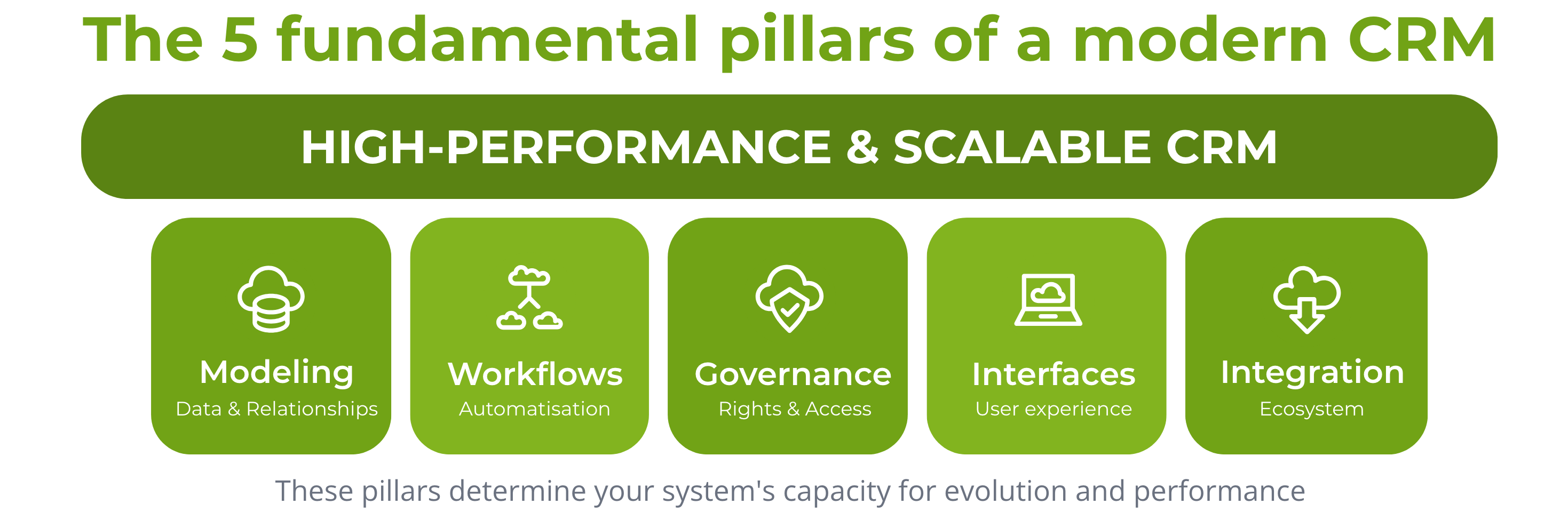
The first fundamental pillar concerns the modeling of data and the relationships between them . Imagine your CRM as a network of cardboard cards connected by colored threads. Each card represents an entity important to your business: a contact, a company, a business opportunity, a project, a contract. The colored threads represent the relationships between these entities: this contact works at this company, this opportunity concerns this contact and this project, this contract has generated this future opportunities.
Let’s take Airtable as a concrete example , which perfectly illustrates this modeling approach. Their system is based on tables that can be linked together, much like a relational database but with a much more accessible visual interface. You create a Contacts table, a Companies table, a Deals table, and you establish links between them. This approach is extremely powerful for getting started quickly because it is intuitive and flexible. You can add fields, create new relationships, and reorganize your views without requiring advanced technical skills.
However, this apparent flexibility hides an important architectural reality. How these relationships are stored and indexed determines how quickly the system can answer complex questions. When you have 100 contacts and 50 companies, displaying all the deals for a given contact is instantaneous. But when you have 50,000 contacts, 10,000 companies, 100,000 historical interactions, and you want to display a view that crosses several of these relationships with complex filters, the architectural differences between a system designed for simplicity and one designed for performance at scale become glaring.
The second pillar focuses on workflows and business process automation . A modern CRM doesn’t just passively store information; it actively orchestrates your business processes. When a deal moves from one stage to the next, it should automatically trigger certain actions: sending an email to the client, notifying the manager, creating a task for the legal department, updating a dashboard.
Notion exemplifies this pillar well with its system of databases and calculated properties. You can create simple automations where changing a property triggers an action. It’s comparable to a system of carefully aligned dominoes: you define a sequence of triggers and actions that follow one another logically. For relatively linear and standardized workflows, this approach works remarkably well.
The limit appears when your business processes become your true competitive differentiator. Imagine that your company has developed a unique sales methodology, with validation steps that depend on customer type, deal size, geographic region, project team composition, and even external factors like seasonality or quarterly targets. These rich processes, which embody your business know-how, require sophisticated conditional logic that no-code workflows can’t always express. You then find yourself making compromises, simplifying your processes to fit the tool’s boxes, losing some of what made you unique in the process.
The third pillar concerns access rights and data governance . In a ten-person startup where everyone knows each other and works on everything, this question hardly arises. But as the company grows, fine-grained permission management becomes critical. Not all of your salespeople need to see their colleagues’ deals. Your marketing team needs to be able to view certain customer data without being able to modify it. Your external partners need access to their own projects but not others. Your finance department needs to see forecast amounts, but only certain profiles can see actual margins.
Notion and Airtable offer permission systems based on workspaces, shared databases, and access levels per user or group. This approach covers standard needs well, but it quickly reaches its limits when you need very fine-grained business rules. How do you express a rule like: “a salesperson can see all deals in their region if they are a manager, otherwise only their own, except for deals marked as strategic, which are only visible to sales managers, and unless the deal involves a partner, in which case the partnerships team must also have access”? This granularity of permissions, which seems anecdotal at first, becomes absolutely essential when the organization becomes more complex and the confidentiality of certain business information becomes a strategic issue.
The fourth pillar concerns interfaces and user experience . A CRM is only useful if teams actually use it on a daily basis, and usability largely determines this adoption rate. Solutions like Notion and Airtable truly excel in this regard. They allow you to quickly create personalized views, Kanban boards, calendars, galleries, and forms. Each user can adapt their interface to their way of working, which is a considerable asset for adoption.
However, these interfaces remain fundamentally generic. They are designed to suit as many use cases as possible, which necessarily involves compromises. While Jakob Nielsen’s Law of User Experience teaches us that users prefer interfaces that respect conventions to facilitate adoption, it also reveals the limits of this approach: when you have precisely identified how your salespeople work on a daily basis, what their most frequent tasks are, and what shortcuts would save them hours each week, you discover that you need an interface tailored exactly to their specific workflow. A single button that, in one click, would create the deal, generate the quote from a template, send the email to the client with attached documents, automatically schedule the reminder in three days, and notify the manager. This fine-grained orchestration, perfectly adapted to your unique business process, is extremely difficult, if not impossible, to achieve with generic interfaces, however flexible they may be.
The fifth pillar, often underestimated at startup but absolutely critical at scale, concerns integration with your existing technical ecosystem . A CRM never lives in isolation. It must communicate with your billing system to track payments, with your ERP to synchronize orders, with your marketing tools to enrich contact profiles, with your customer support platform to have a unified view of customer relations, with your business intelligence tool to feed your strategic dashboards.
No-code platforms like Notion and Airtable understand this challenge and offer rich integration ecosystems, often via third-party tools like Zapier or Make. You can connect hundreds of applications in just a few clicks, without writing a line of code. This approach is excellent for getting started and covers many standard needs. But it also creates multiple dependencies and weak points. Each integration runs through a third-party API, with its own throughput limits, costs, and synchronization delays. When you need real-time synchronization between your CRM and inventory management system so your salespeople can instantly see product availability, or when you need to orchestrate complex data flows between five different systems, these third-party integrations show their structural limitations.
Structural limits that emerge with growth
Now that we’ve broken down the five fundamental pillars of a modern CRM, we can understand why certain architectural choices, perfectly suited to one scale, become constraints at another. It’s important to clarify that we’re not criticizing Notion or Airtable, which are excellent tools that have democratized the creation of business applications. We’re simply explaining, objectively, why their design choices reach structural limits in certain specific contexts.
The first limitation that appears concerns technical scalability and performance . Simplified relational database architectures, however sophisticated they may be, have performance constraints when the volume of data grows significantly and queries become more complex. To understand this phenomenon, imagine the difference between looking for a book in a local library and looking for a specific work in the collections of the National Library of France. In the first case, you browse a few shelves and quickly find what you are looking for. In the second case, without an industrial cataloging system with sophisticated indexes, rich metadata, and an optimized search architecture, the task becomes almost impossible.
When your CRM database contains 50,000 contacts, 20,000 companies, 100,000 historical opportunities, and hundreds of thousands of interactions, and you need to display a complex view that filters and cross-references multiple entities using multiple criteria, the architectural differences become tangible. Load times lengthen, filters become slow to apply, and the user experience gradually degrades. Your salespeople, who need to be responsive to the customer, lose patience and look for workarounds, creating mini-parallel systems that fragment your data.
The second structural limitation emerges with the increasing complexity of your business processes . No-code workflows are remarkably effective at orchestrating standardized and relatively linear processes. But when a scale-up develops business processes that constitute its real competitive differentiation, it needs much more sophisticated business logic.
Let's take a concrete example that we've encountered at several clients. Imagine a sales commission calculation system that needs to take into account the type of product sold, the geographic region, seasonality, individual and collective quarterly objectives, recurring deals versus new customers, margins achieved, and even conditional bonuses linked to specific events. Expressing this logic with formulas in cells or no-code workflows becomes a real headache. You end up creating byzantine structures that are difficult to maintain, where changing a business rule requires modifying dozens of different places. Real programmatic logic, written in code, allows you to express this complexity in a structured, testable, and maintainable way .
The third limitation concerns governance, compliance, and auditability . As a company grows and becomes more professional, it often has to meet increasingly stringent regulatory requirements. The GDPR imposes specific obligations on the management of personal data. Some ISO certifications require detailed audit logs of all changes to sensitive data. Some regulated sectors require the ability to precisely track who accessed what information and when.
No-code platforms offer a general security and compliance framework that covers the most common needs. However, they don’t always allow for the implementation of very fine-grained data retention policies, sophisticated consent processes, or audit logs with the required level of granularity. We supported a client who needed to be able to produce, for each sensitive customer data item, a complete history of all accesses: who had viewed this information, when, from where, and in what business context. This requirement, which initially seemed anecdotal, became a barrier to their certification and impossible to meet with their no-code CRM.
The fourth limitation concerns strategic independence and control of your technological destiny . This notion takes up a concept that we developed in our article on off-the-shelf software versus custom development . When your CRM gradually becomes the heart of your competitive advantage, when it embodies your unique business processes and your differentiating way of interacting with your customers, depending on a third-party publisher for its evolution becomes a significant strategic risk.
If tomorrow the publisher of your no-code platform changes its pricing policy and triples costs, you are locked into it and have no choice but to accept or migrate urgently. If a key feature you use daily is removed or significantly changed, you must adapt even if it disrupts your processes. Even more fundamentally, if all your competitors can use exactly the same tools as you, configured in a similar way, where does your business differentiation lie? Sustainable competitive advantage rarely comes from using standard tools in the same way as everyone else.
The fifth limitation concerns fine-tuning the user experience and daily productivity . Generic interfaces are excellent at first because they allow everyone to appropriate the tool in their own way. But after several months of intensive use, you begin to precisely identify the frictions in your teams’ daily lives. Your salespeople perform the same six-click sequence fifty times a day for a recurring task. Your project managers must navigate between four different views to gather the information needed for a decision. Your managers must export data, manipulate it in Excel, then reimport it to generate certain reports.
All of this accumulated micro-friction represents hours of productivity lost each week by each user. When you multiply that by the number of users and by fifty-two weeks, the cost becomes considerable. An interface tailored precisely to your specific workflows, automating repetitive tasks, bringing scattered information together in a single view, and offering intelligent context-based shortcuts can radically transform your teams’ daily productivity. But this fine-grained optimization is extremely difficult to achieve with generic interfaces that must remain flexible for all their users.
The Agerix decision-making framework: knowing when to take the plunge
Given these findings, the point is not to say that tailor-made is always better. That would be as absurd as claiming that a standard solution fits all contexts. True intelligence lies in accurately assessing your specific situation and determining which approach is most relevant to you, at this point in your journey.
Agerix has developed a structured decision-making framework, inspired by the Cynefin model we use in our feasibility studies, but adapted specifically to the question of choosing a CRM. This framework evaluates several critical dimensions of your context to determine whether you are operating in an environment where an off-the-shelf solution is sufficient, where a configured no-code platform can meet your needs, or whether you are in a situation where custom development becomes a justified strategic investment.
The first dimension to assess concerns the complexity and specificity of your business processes. If your business processes are relatively standard and close to what the market does in your sector, a packaged or configured no-code solution may be perfectly sufficient. There is no point in reinventing the wheel when a standard one works very well. On the other hand, if your business processes constitute a significant part of your competitive differentiation, if you have developed a unique lead qualification methodology, if your customer nurturing approach is specific and gives you a measurable advantage, then standardizing these processes to fit them within the constraints of a generic tool amounts to voluntarily giving up a competitive advantage.
The Cynefin model helps us refine this analysis. In a simple or complicated context, where cause-and-effect relationships are clear and best practices are known, standard solutions work perfectly. But in a complex context, where you must continually experiment, adapt your processes, learn from your results, and evolve your approach, you need a tool that can evolve at the same pace as your business understanding. Customization offers the agility that standard solutions cannot guarantee.
The second dimension concerns the volume of data and the growth rate of your business. A ten-person startup testing its product-market fit has absolutely different needs than a hundred-person scale-up doubling its revenue every year. We generally offer indicative thresholds, which must of course be adapted to your specific situation. Below a thousand active contacts, a few thousand historical interactions, and around ten users, no-code platforms are generally more than sufficient and very effective. Between a thousand and ten thousand contacts, with dozens of users, you enter a gray area where the decision depends heavily on the other dimensions we evaluate. Beyond these thresholds, or when your growth is very rapid and you anticipate reaching these volumes within twelve to eighteen months, anticipating with an architecture designed for scalability will save you from a painful and costly migration in the near future.
The third dimension assesses your compliance, security, and auditability requirements. If your industry is highly regulated, you process particularly sensitive data, or you must meet strict certifications, the level of fine-grained control offered by custom development may become non-negotiable. We supported a healthcare company that had to migrate from a no-code solution to a custom CRM precisely because their certification auditors required a level of traceability and access control that the generic platform couldn’t guarantee. In these situations, customization is no longer an optional strategic choice; it becomes a regulatory necessity.
The fourth dimension analyzes the necessary integration with your existing technical ecosystem. If your CRM must communicate in real time with a proprietary ERP that you have developed, with a production management system specific to your industry, with a business platform that constitutes your core business, generic connectors will multiply points of friction, latency, and fragility. Each third-party integration adds a layer of complexity, recurring costs, and risk of failures. Customization allows you to build robust native integrations, with synchronization logic perfectly adapted to your specific needs and without dependence on third-party APIs that can evolve or disappear.
The fifth dimension, perhaps the most strategic, concerns your three- to five-year vision. Where will your company be by that time? What strategic features will you need to have developed? What level of sophistication do you expect from your customer system? If you anticipate a significant evolution of your business model, the opening of new sales channels, internationalization with specific country-specific regulations, or the development of high-value-added services that will require complex orchestration, it’s better to start with solid and scalable foundations.
This thinking aligns with our concept of sustainable architecture, which we are developing in our projects. Investing in a software architecture designed to scale effectively costs more upfront than going for a quick fix. But this initial investment can prove particularly profitable in the medium and long term by avoiding costly migrations, accumulating workaround developments, and technical debt that gradually paralyzes your ability to scale. The CARPA project we developed perfectly illustrates this approach. Designed from the outset with a modular and extensible architecture, it was able to integrate new regions with their own regulatory specificities without requiring a major overhaul, simply because the initial architecture had anticipated this need for scalability.
To help our clients synthesize this multidimensional analysis, we offer a decision-making matrix that crosses these different dimensions and allows you to quickly visualize where your context lies. This matrix is obviously not a magic formula that would produce a binary answer, but a structured thinking tool that helps to objectify the decision and identify the trade-offs to be made.
The Agerix approach for tailor-made CRM that keeps its promises
If your analysis leads you to seriously consider custom development, a legitimate concern immediately arises. Custom development has historically had a bad reputation, and for good reason. Too many projects have slipped on schedule, blown budgets, delivered rigid systems that quickly become obsolete, or worse, never really completed. This reality explains why so many companies prefer the perceived security of an off-the-shelf solution, even if it doesn’t perfectly match their needs.
At Agerix, we've developed a specific methodology that aims to avoid these classic pitfalls. Our specialized design office approach is fundamentally different from that of a traditional development agency, and this distinction makes all the difference in project success.
It all starts with a thorough feasibility study phase that we systematically conduct before writing the first line of code. Unlike many players who jump straight into development after a few scoping workshops, we invest time to truly understand your business processes, identify real priorities versus secondary desires, precisely model workflows, and assess the technical and economic feasibility of the project. By applying rigorous prioritization methodologies like the MoSCoW matrix , we distinguish between what is truly essential for launch and what can be postponed to a later version. This phase helps avoid the most costly mistake of all: building the wrong system, even if it is built perfectly.
In the Académie du 13 project we developed, this feasibility study allowed us to discover that what the client thought was their number one priority was not, in fact, the real point of friction in their educational process. By taking the time to finely model the interactions between the different actors, we identified that another functionality, initially considered secondary, was in fact the one that would bring the most immediate operational value. This discovery completely reconfigured the project’s priorities and ensured that we focused our development efforts where the impact would be greatest.
The second cornerstone of our methodology is the systematic use of the RACI matrix to clarify roles and responsibilities within the project. The RACI acronym defines for each decision and each deliverable who is Responsible for execution, who must Approve the decision, who must be Consulted, and who must be Informed. This clarification, which may seem administrative at first glance, actually avoids weeks of misunderstandings, fruitless back-and-forths, and accumulated frustrations.
On the Académie du 13 project, clearly defining from the outset that the educational manager was the final decision-maker on all aspects of student monitoring workflows, while the administrative director approved aspects related to billing and registration, helped avoid endless meetings where everyone gave their opinion on everything. Decisions were made quickly, with the right people, and the project moved forward smoothly.
Our third methodological principle is based on an iterative and incremental approach rather than a funnel-based development approach. Rather than spending eighteen months developing a complete system before putting it in the hands of end users, we deliver usable, functional versions every month or two. Each iteration delivers a coherent set of features that can be used in production, allowing teams to start working with the tool, provide concrete feedback based on actual usage, and adjust priorities for subsequent iterations.
This approach drastically reduces the risk of building something no one will use. On the Travel Safe project we developed, early user feedback after the initial release revealed that some of the business terms we were using in the interface weren’t fully aligned with the operational teams’ everyday vocabulary. By identifying this after the first month rather than a year of full development, we were able to adjust immediately, avoiding building an entire system on terminology that would have created friction in use.
The fourth pillar of our approach concerns the sustainable architecture that we design from the start . A well-thought-out software architecture, with a clear separation between the business logic, the data layer, and the user interface, allows each component to evolve independently without compromising everything. This modularity is what differentiates a rigid system that quickly becomes obsolete from a scalable system that can accompany the company for many years. This ability to evolve also relies on rigorous development practices such as clean code , which ensure that the system remains understandable and maintainable even several years after its initial creation.
The CARPA project perfectly illustrates this approach. We designed the architecture with the explicit anticipation that new regions with their own regulatory specificities should be able to be integrated gradually. When new regions arrived with different business rules, we were able to integrate them by extending the system rather than making major changes. This ability to expand without redesign is the hallmark of an architecture designed to last and evolve.
Finally, our fifth core principle recognizes that a custom CRM isn’t a project with an end in sight; it’s a living asset that continually evolves alongside your business. We don’t deliver a system and then disappear. We support our clients over the long term with evolving maintenance contracts that guarantee not only the rapid correction of potential bugs, but also the ability to regularly add new features as your business needs evolve. This long-term relationship transforms custom development from a one-time risk into a lasting strategic partnership.
From CRM as a commodity to CRM as a strategic advantage
Together, we've explored the path from a deep understanding of what modern CRM truly is to the criteria that determine which approach best fits your specific situation. The conclusion emerging from this analysis isn't that custom is always superior, but that choosing between off-the-shelf solutions, no-code platforms, and custom development is fundamentally a strategic decision that will shape the future of your business.
The real challenge isn’t choosing between a cheap and an expensive solution. It’s choosing between a tool that’s sufficient for your needs today and a system built to support your growth tomorrow. A scale-up that settles for standard tools used in exactly the same way as all its competitors is potentially depriving itself of a sustainable differentiation lever. Conversely, a startup in the process of finding product-market fit that invests in a sophisticated custom CRM before validating its model would likely be making a poor resource allocation decision.
True strategic intelligence consists of recognizing where you are in your trajectory, what your real medium-term ambitions are, and what approach will best align your customer system with these ambitions. Tools like Notion and Airtable are remarkable for getting started quickly and testing approaches. They can even be sufficient for the long term if your processes remain relatively standard. But when your growth accelerates, your business processes become more complex and become your differentiator, and deeply integrating your CRM into your technical ecosystem becomes critical, then investing in custom development ceases to be an expense and becomes a strategic investment.
At Agerix, we’ve supported enough companies through this transition to know that there’s no perfect time to make this transition. There are appropriate times and premature times, and the difference lies precisely in the structured analysis we’ve proposed in this article. If you recognize yourself in the situations we’ve described, if several of the dimensions of our decision-making framework resonate with your current context, it’s probably time to seriously explore this option.
We invite you to speak with the Agerix team, not to immediately sell you a development project, but to carry out a precise diagnosis of your situation together. This conversation will allow us to understand your business processes, your ambitions, your constraints, and to advise you objectively on the approach that truly corresponds to your context. Sometimes, this analysis leads us to recommend sticking with a standard or no-code solution because the time is not right. Other times, it reveals that investing now in customization will save you considerable money over the next two years while giving you a lasting competitive advantage.
This consulting rather than sales approach reflects our identity as a design firm. We don’t seek to develop for the sake of developing. We seek to solve complex business problems with the most relevant solutions, and sometimes that solution isn’t custom development. But when it is, we aim to do so with a proven methodology that transforms a risky project into a lasting strategic partnership that truly delivers results.
Contact us to explore together what approach will transform your CRM from a simple operational tool into a real lever for strategic growth.
FAQ – Anatomy of a Modern CRM and how to choose an approach
Frequently asked questions
-
A modern CRM is more than a contact list. It stands on five foundations: a solid data model linking contacts, companies, opportunities and projects; workflows that orchestrate business actions; fine-grained governance for access and audit trails; interfaces designed for daily use; and robust integrations with billing, ERP, marketing, support and BI. The quality of decisions on each axis shapes long-term resilience, speed, process consistency and the ability to evolve as scale and complexity rise.
-
Modeling defines how entities and their links are stored, indexed and queried. With few records everything feels fast; once you reach tens of thousands of contacts, companies and interactions, any cross-view needs well-tuned joins and filters. Without a clear relational structure, fit-for-purpose indexing and schemas aligned to real queries, response times grow, views bloat and experience suffers. A model aligned to user journeys and expected analytics questions avoids thresholds and supports growth.
-
No-code workflows work well for linear scenarios: notifications, simple assignments, conditional updates. When business logic mixes segments, amounts, regions, goal calendars, exclusions and exceptions, chains of actions become hard to keep readable and reliable. Rules disperse across formulas and triggers, making maintenance tricky. A rules engine that enables rich, testable and versioned logic covers advanced situations without stacking fragile automations or multiplying failure points.
-
As organizations grow, differentiated access by role, region, deal status or sensitivity becomes decisive. You must express precise rules, trace who viewed or changed what, and produce usable logs for audits. Generic setups cover common needs, but struggle with stringent retention, consent and proof-of-access policies. A complete setup combines hierarchical authorization models, controlled inheritance, explicit exceptions and timestamped traceability to balance confidentiality, compliance and smooth day-to-day use.
-
Generic views help adoption at first but ignore team-specific recurring actions. Opening many screens for one task, repeating click sequences and exporting data for rework all add up. An interface shaped to real routines groups the right information, automates frequent sequences, reduces manipulations and aligns wording with business vocabulary. This tailoring boosts execution speed every day and lowers the risk of bypassing the tool with ad-hoc workarounds.
-
Slowness is cumulative: schemas built for early stages, missing indexes, unselective queries, real-time computations on derived fields, poorly designed async integrations and overstuffed views. At volume these factors reinforce each other. Optimization relies on well-chosen indexes, materialized views or caches for expensive aggregates, strict pagination, pre-compute strategies for dashboards, and a review of critical queries using real execution traces.
-
A CRM must exchange with billing, ERP, marketing automation, support and analytics. Generic connectors help at the start but add latency, rate limits and recurring costs. For strategic exchanges, native integrations or dedicated orchestration services bring resilience, clear error handling, retries and transactional consistency. Mapping data flows, defining systems of record and choosing the right frequencies (real time, near-real time, batch) prevent misalignment and duplication.
-
Base the decision on several axes: specificity of processes, data volumes and growth pace, compliance and audit needs, integration depth, and a 3–5-year vision. In simple or merely complicated contexts with stable practices, a standard or configured no-code tool fits. When the environment is changing, differentiation depends on sophisticated rules, and deep ecosystem exchanges are required, a custom base secures the path. The key is to anticipate thresholds to avoid a forced and costly migration later.
Eric Lamy
Published on 6 October 2025 — updated on 7 October 2025